In October 2004, a report on Romania published by the European Commission (in view of its ambitious goal to join the European Union)
It underlined the ‘inefficiency of the fight against corruption and the low quality of justice’, also mentioning that these were the two main obstacles preventing Romania from becoming a member-state. Due to the situation in the country, however, it did not seem possible to overcome the obstacles before 2007 – the year of the country’s accession to the EU. For that reason the European Commission imposed extremely tough conditions, the so called “red flags” to the new government led by Călin Popescu Tăriceanu. By the spring of 2005 they had to present four crucial documents: the anti-corruption strategy and its action plan, the strategy for the reform of the justice system and its action plan. Otherwise accession would have been postponed.
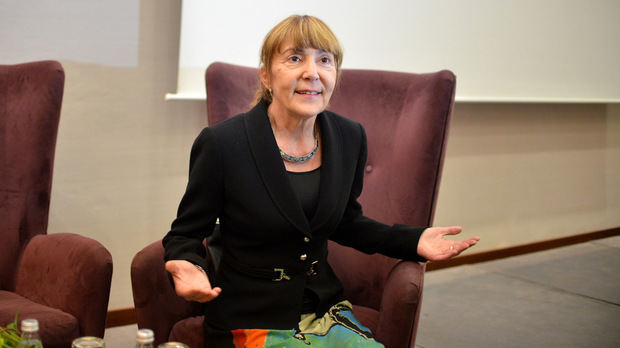
In December 2004, Monica Macovei became Minister of Justice.
Macovei was an independent minister; she did not belong to any political party. She was given the almost impossible mission to deal with all these challenges in the judicial system and prepare the first solid steps on Romania’s European trajectory.
Her first words as a minister, during the press conference held after her appointment, were: “the situation is on fire”.
Macovei started her work immediately.
She disbanded the Justice Ministry's secret service, which had been wiretapping judges and politicians and gathering information, which, Macovei stated, "we do not really know where it ended up or with whom." It was the first time in Romania that a secret service was disbanded. She, however, brought new procedures for checking whether judges and prosecutors collaborated with the former Securitate. She prohibited judges and prosecutors from cooperation in any way with current intelligence services. She made sure to have legislation against immunities for high officials in former governments and to make tax evasion a criminal offense. She secured independence for the prosecutors and judges, increasing their salaries at the same time, to make them less susceptible to bribes. She set up the National Anticorruption Directorate and encouraged it to target large-scale anticorruption cases; for the first time in the history of the Romanian post-communist judiciary, members of the Parliament and high level officials were investigated and prosecuted. The most prominent conviction was that of former Prime Minister Adrian Năstase, arraigned by former head of Directorate, prosecutor Daniel Morar.
She obliged by law politicians to publish their declaration of income and interests and she made conflict of interests a criminal offence.
On the April 18, 2005, The National Anticorruption Strategy and The Strategy on the Judicial Reform were published. On the April 23, 2005, in Luxembourg, Romania signed its Treaty of Accession to the European Union. Former Enlargement Commissioner Olli Rehn stated, at the time, that “Romania has started to tackle the accession requirements seriously, especially in the field of justice reform and the fight against corruption. I am glad to say today that all the key strategic documents required as a result of the negotiations have recently been transmitted by the Romanian Government to the Commission on time. These concern the fight against corruption, reform of the justice system and border security. The documents are currently being assessed by the Commission.”
Looking back at the reform of the judiciary, 9 years later, Monica Macovei talks about the changes brought to the country by this reform and its consequences for the society, as a whole.
How did the judicial system change as a whole?
Any change from within is impossible. One needs an agent of change coming from the outside. Profound reforms are hard to accomplish and to be successfully brought to an end, because the first one to react and oppose to change is the system which needs those reforms. There are judges and prosecutors, even today, who were and remain against any attempt of change within the justice system.
To give you an example, unification of case law was an important challenge and still remains an issue. At the beginning, part of the judges opposed this process, arguing that it affects their independence. Then they realized that it was not true and that everywhere in the world a unitary judicial system is needed. Justice is not lottery. It needs clear and thorough rules which need to be followed by everybody. Otherwise people do not trust the judiciary.
Independence of justice does not mean the right of the judges and prosecutors to do whatever they want. It means the people´s right to independent judges and prosecutors.
Then, people inside the system are very important.
Not everybody can be a judge or a prosecutor; it is the type of professional path that involves special qualities and skills. Apart from very solid knowledge, one needs to be strong, balanced and capable of taking risks.
There are more and more judges and prosecutors involved in and working on complex corruption cases. They became models for some of the others and continue to build trust. The fact that they are independent and can investigate, prosecute and convict oligarchs and politicians, regardless of their position or political color, is a huge step forward. I think this is the main benefit that we have from the reform of the judicial system in Romania. As a matter of fact, judges and prosecutors must not wait for someone to give them independence. They must take this independence themselves.
How did the state change?
The state that was captured by corruption, groups of hidden interests and organized crime could partially be returned to its citizens and given true freedom, through the reform of the judicial system. Along this process, the state itself gained strength; solid ground for democratic values was built.
A state subject to the rule of law means that those who steal and those who are corrupt have to answer equally before the law - the prime minister, the politician, the member of parliament, the minister, the judge, the prosecutor, the mayor, the heads of the football clubs, just like any other citizen. They should obey the same rules. This is what I call “a healthy democracy”.
How did the society change?
The society started to pay a lot of attention to its politicians and their decisions; to the high corruption cases. Expectations in terms of length of trials or unitary practice are higher than they were 10 years ago. Accountability increased. As we speak, trust in the DNA - the National Anticorruption Directorate, is 70%.
People are gradually becoming aware of the costs of corruption and the need for efficient and independent justice. These are compulsory conditions in order to properly fight against corruption.
Corruption undermines fundamental institutions of the state. Corruption brings poverty. Corruption kills. Our society no longer wants to be affected by its consequences. In Romania, after a fire in a club in Bucharest, 63 young people died, also because of acts of corruption involving local authorities. People knew this and took to the streets to ask for a new political class. A government fell and a prime minister was dismissed. So it is possible.
It was a fundamental change in the reaction of the citizens, of the society as a whole and this is related to the reform process. To all reforms.
And how is this all connected to the judicial reform?
A strong judicial system leads to a strong society. The proper functioning of all the other powers is based on the legal system. Justice ultimately decides who is right. The private sector also depends on the judiciary and its independence.
If the judicial system is clean, it will do its job and clean up the political scene and the country; it will get rid of corruption.
This is why all efforts to eradicate corruption must first and foremost target eliminating corruption from the justice system itself. Then every failure in the legal system and restriction affecting its independence has a strong impact on the judicial cooperation with the European Union and the United States of America.
If you have a system which is not reformed and inefficient, this will severely affect the international cooperation in combating organized crime, trans-border corruption, money laundering, fight against terrorism (terrorism which is financed by organized crime) due to the lack of trust. Highly important cases are not handled properly and our safety is at stake.
For all of these reasons, we need an independent and professional judicial system. Always remember: where there is no law, there is nothing.
by Dimo Gospodinov
