Bulgaria faces a subtle dilemma
Unless we increase our country's export potential and competitiveness on the global markets, we are bound to further increase our external debt to a point when this possibility is exhausted and we will have to accept a lower standard of living.
This choice is somehow unnoticeable since the key macro indicators of the country seem stable: GDP rose by 3% in 2015, there is virtually no inflation, while unemployment decreased from 11.8% to 10% over the past two years. The only macroeconomic indicator highlighting this choice is the government and government guaranteed debt that has doubled compared to its levels in 2011, when it was 12.8 billion BGN, while today it reaches 23.4 billion BGN.
To offer insight into the economic reality behind those macro- indicators The Center for Economic Strategies and Competitiveness and MOVE.BG conducted a microeconomic analysis incorporating data for over 300,000 Bulgarian companies.
On the basis of this analysis, we found out that in case the financing through loans and EU subsidies stops today, Bulgaria would lose 25% of its economy. On the other hand, if the average productivity of the companies with export potential rises to the levels of each sector's top performing 10% companies, Bulgaria would have positive and sustained economic growth without relying on loans and EU subsidies.
Over the past few years we imperceptibly became a country that relies on foreign borrowing and EU subsidies for 1/4 of its economy. The good news, if we are to reverse this downward trend, is that we do not need to reach out global success stories, but to learn from the best-performing companies with export potential in Bulgaria so the rest could aim for their result and raise the average level. How this could happen is the big question. For a start, we need to realise that increasing our export potential has to be our current greatest priority, along with sharing and replicating the good practices of successful companies in each industry.
The economic growth of a country with a small and open economy depends largely on the exports of goods and services and/or the attraction of external capital in the form of foreign investments, loans or subsidies.
Bulgaria is an example of such economy, where the size of the domestic market is relatively small and the access of Bulgarian companies to foreign markets is virtually unlimited. Improving competitiveness and standard of living depend on the companies competing on the global markets. These Bulgarian companies are the key to a sustainable economic development of Bulgaria. Therefore, the focus of the analysis is on the export sectors.
The simulation models have shown us very clearly what would happen to the Bulgarian economy if the exporting companies in each sector achieve the productivity levels of the best-performing companies in the concerned sector, regardless of their size. It is not even a question to compare the productivity in similar sectors at European or world level, but nationally.
The sector data analysis give us the idea what would happen to the Bulgarian economy, and our standard of living respectively, without the European structural funds and external debt, major part of which is spent on sustaining low-productivity companies focused solely on the Bulgarian market.
Should we feel secure about the relatively positive development of the Bulgarian economy?
In order to understand with greater clarity the macroeconomic data, it is recommended to study the microeconomic data of which the macro data is constituted. We analyzed the actual state of the Bulgarian economy following the understanding that in any given economy solely the company creates added value while the public sector has only redistributive functions. We examined the company data of more than 300,000 businesses in Bulgaria, one by one, in order to understand whether our economy, as it stands, ensures stable growth in our standard of living.
Our analysis reveals that:
- Of all companies in Bulgaria merely 21% have export potential (of which 3.5% are in "Agriculture" and 0.14% in "Mining and extraction"), while the rest focus on the domestic market. When a country has no large foreign investments and does not rely on loans and subsidies for its standard of living, the only one way to improve its overall well-being is through increased export potential. Although the domestic market companies create added value and employment, they have no relation to the competitiveness of a country and its standard of living, when this country has a small open economy. In the long run, the companies of which largely depends our standard of living are those with export potential – representing only a fifth of all operating in Bulgaria.
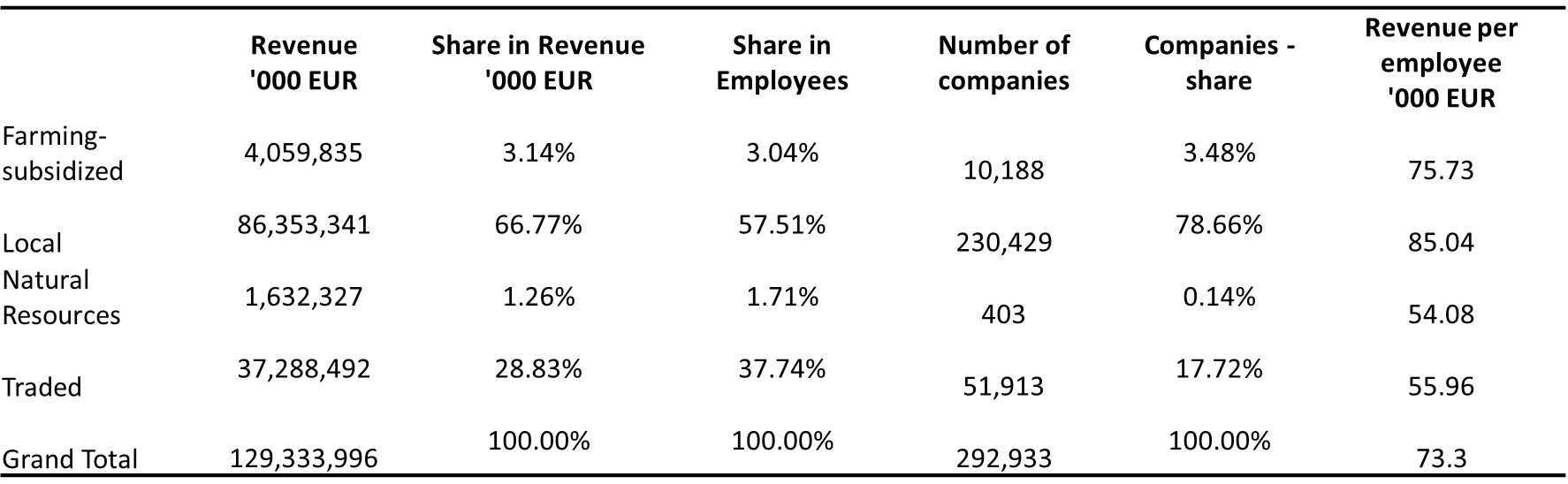
- The productivity of various businesses, measured of a company's total annual sales divided by the number of its employees, has the following values:
- companies with export potential (without "Agriculture"): € 56.000 per employee
- companies in "Agriculture": € 75.000 per employee
- companies working solely on the domestic market: € 85.000 per employee
These figures are surprising, given that the economic theory tells us that in a country, the most productive companies are those with export potential.
On a free market the companies with export potential always have a higher (or equivalent) productivity compared to those operating on the domestic market. Only in this way they could cope with the global competition. Put another way, if the companies acting on the domestic market have high productivity rates, they would most likely direct their attention to the external markets, which would give them access to much greater development possibilities. Contrary to the economic theory, the data of the Bulgarian companies indicate abnormality: businesses operating solely in Bulgaria, in industries with no export potential, managed to generate higher revenue relative to the number of their employees than those with export potential. Another abnormality our analysis reveals, is that while globally the agriculture is not among the sectors with high added value, in Bulgaria the companies in this industry have higher revenues relative to their employees than the companies in industries with export potential. According to the findings, in Bulgaria it is better to be agricultural producer or construction company that builds highways, with operations entirely focused on the domestic market, rather than electrical engineering and electronics company competing with global companies on the international markets. With this example it already begins to look more familiar to our reality.
There is a clear direct relation between the current economic performances in our country and the EU subsidies funnelled into sectors that do not create long-term competitiveness in our economy.
However, this picture has a tangible problem. If we take for a metaphor a family where the wife works and earns a wage while the husband stays home and cooks, and apply the same model by which the Bulgarian economy currently works, the husband has a higher income than the wife, although he does not work outside the home. Such dynamics can occur within a family only in three ways - the family takes consumer credit, regarded as income of the husband; the family takes subsidies from relatives, fully to be at the disposal of the husband; the stay-at-home husband takes a disproportionately large share of the household budget. The problem is the consumer credit has to be paid back and a subsidy on disposal does not depend on the family but on the relatives. Juxtaposing the family and the Bulgarian economic reality we see domestic market companies generating higher revenue per each and every of its employees compared to those with export potential. Such scenario is possible only short-term, in the presence of external financing in the form of loans, grants or any other foreign capital.
Bulgaria is neighbouring Greece and Turkey who face considerable challenges; is on the path of migratory flow from the Middle East; is not far from a source of instability such as Russia; and is part of a union in the midst of existential crisis. In such circumstances, in the foreseeable future Bulgaria could not expect major global flows of foreign investment in the form of foreign direct investment. Over the past five years, foreign direct investment amounts to approximately €1.5 billion per year - about 6-fold less than the peak reached in 2007. These relatively low levels are likely to remain. Currently, the EU subsidies represent direct investment capital of around 1.8 billion annually for the country. Now that Brexit is expected to detract nearly 10 billion euro contribution to the European budget, this income from EU subsidies becomes increasingly uncertain. Only the possibility of foreign loans remains. Bulgaria's government and government guaranteed debt has doubled compared to its levels in 2011, when it was 12.8 billion BGN, while today it reaches 23.4 billion BGN.
To this end, achieving sustainable economic development in the future means not only increasing our export potential, but its increase should reach such levels as to compensate those already taken loans.
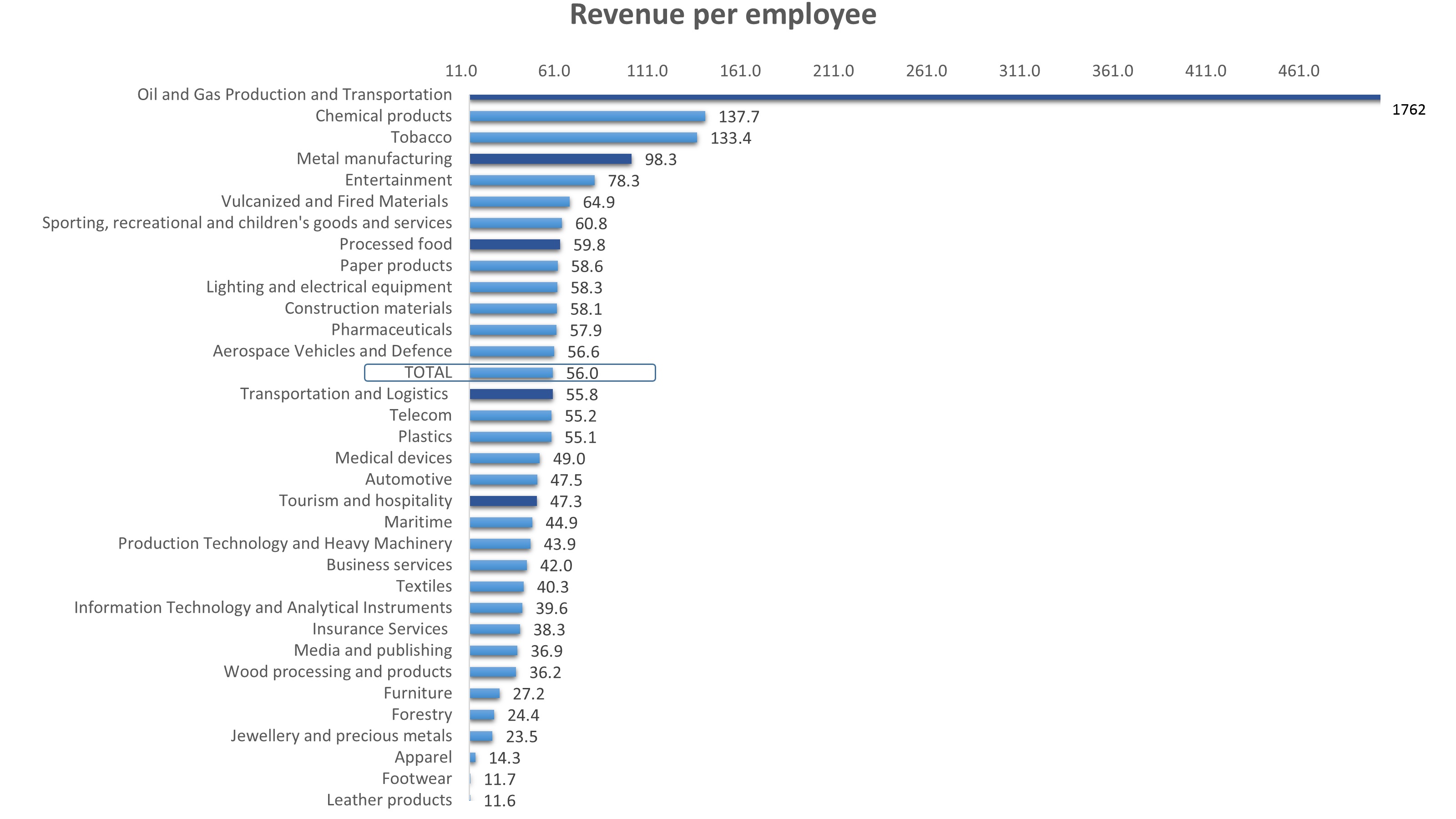
- The economic outlook derived from the microeconomic analysis of the companies on the Bulgarian market indicates that our country has companies with export potential in industries characterized by high added value around the world, but in Bulgaria they have low productivity as an indicator of low added value. The actual examples indicate that the average revenue generated by an individual employee in the IT sector is only 39 600 euros; in companies manufacturing medical devices - € 49 000; in the pharmaceutical industry- 57 900 euros. This means that the Bulgarian companies with export potential, even when in high added-value industries, are engaged in low added-value activities. This fact can be considered as a problem but also as an opportunity, given that there is no need to change the Bulgarian industry portfolio but simply to climb up the value ladder in the existing export potential industries. It is possible through targeted policy in support of the high added-value industries; favourable administrative and educational infrastructure; and systematic work on changing our reputation of a CMT manufacturing destination and repositioning our state as an internationally recognizable centre in electrical engineering and electronics.
What actually tell us the data about the future standard of living in Bulgaria?
The data revealed that 79% of companies in Bulgaria are active in sectors without export potential and they constitute about 67% of the country's economy. If they cease to be directly or indirectly funded through the growing external debt, their per employee revenue would drop at least to the levels of the companies with export potential. In real terms this means a decrease from the current € 85 000 per employee to € 56 000 per employee - a decline of 34%. The same could be said about the heavily relying on EU subsidies and government subventions agricultural sector. Should they be taken away, its productivity as revenue per employee would be reduced from the current € 76,000 to less than 56,000 euros - a decline of 26%.
The analysis made clear the Bulgarian economy's dependence on subsidies. In case the State stops funding the economy through external loans, and without the EU subsidies, Bulgaria's GDP would drop by about 25% due to the above-described decline in revenue in companies without export potential and those in the agriculture. In other words, 1/4 of our current standard of living is based on external borrowing and European subsidies. If we fail to increase our revenues through export and Bulgaria continues to rely not on competitiveness but on external financing, each year the risk of decline of our standard of living would increase. At the moment when our capacity for foreign debt exhausts, our economy will sharply shrink after the example of Greece.
How can we develop in a sustainable way?
To achieve sustainable economic development Bulgaria needs a focus on the effective sectors with export potential, and to increase the added value of those already in high-tech sectors of the economy. This leads to rise in the standard of living and limits the need for foreign debt. Coordination of cluster policies; coordination within the clusters on the basis of good examples; increased productivity of the companies with export potential to the level of best performing in the cluster, is of key importance.
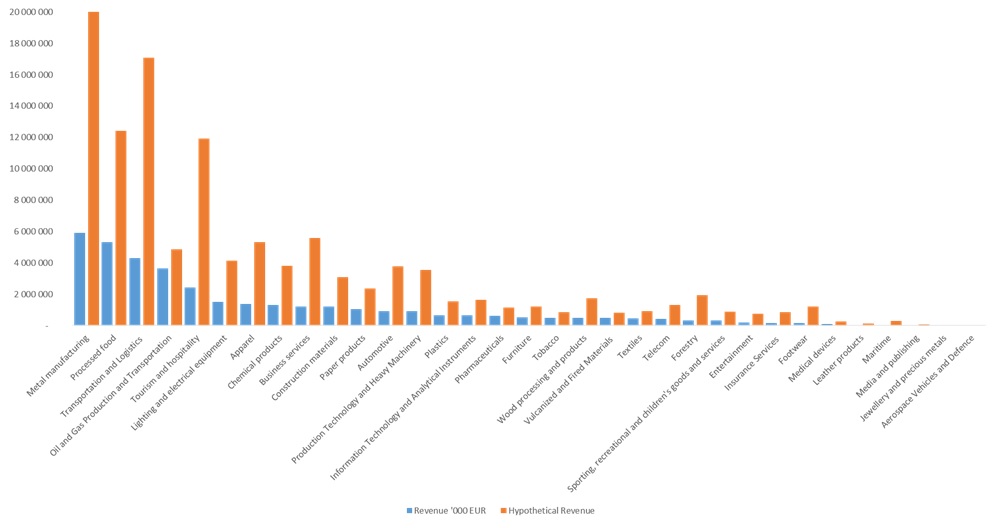
The simulation models give us an insight what would happen if the companies in any given cluster catch up with the performance of the most productive 10% of the companies in it - the sectors with export potential would increase its revenue by 224%. This would affect our economy with positive growth of 25% and would be sufficient to offset the need for foreign debt.
The main finding, if we are to be calm for the standard of living in Bulgaria, is the necessity to raise the added value of the clusters with export potential to the level of the top-performing 10% in each of them. Such restructuring would eliminate the need for external debt. Until then our standard of living would eventually decline, bringing us to the Greek scenario. Such a risk increases with each year of delay.
The choice is ours. It is the responsibility of each of us. The possibility of improvement lies before all of us. One thing is certain - today's apparently positive macro data do not show the actual trend revealed after we take a look at the indicators of 300,000 active companies in Bulgaria.
224% increase in revenues following the productivity increases of the export clusters