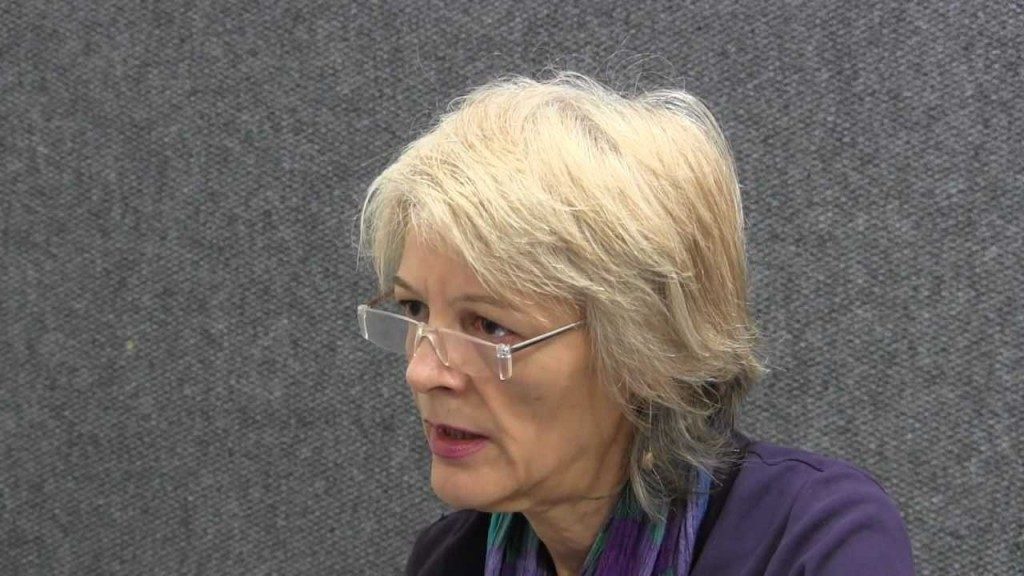
The lecture is a part of the initiative in the Civic Platform of MOVE.BG regarding its strategic partnership in the campaign “European Initiative for Media Pluralism,” which aims to collect at least 13,500 signatures from Bulgaria to achieve effective legislation to prevent the concentration of media ownership and the ensure the independence and freedom in the media in our country. We – MOVE.BG, have ambitiously set a goal of collecting 20,000 signatures from Bulgaria, considering that media freedom in the country is the clearest evidence of a functioning democracy. You can support media freedom by signing HERE.
What do these numbers tell you: 357, 114, 87?

Nelly Ognyanova, Doctor of Law (1985), Doctor of Political Science (2006) is a Bulgarian expert in media law, and a professor at Sofia University “St. Kliment Ohridski.” There she teaches European Media Law and Policy of the European Union. During the 90s she was a member of the National Council for Radio and Television, and in 2001 was vice president of the National Telecommunications Commission. Professor Ognyanova headed a steering group to develop national strategies and programs for the development of the information society (adopted by the Council of Ministers in 1999). Professor Ognyanova guided the Bulgarian Institute for Legal Development in 1996. She is currently the head of the Department for European Studies and Philosophy Faculties at the Sofia University “St. Kliment Ohridski.”.
Throughout the course of the lecture answers were given to these questions among others:
Does the presence of many media outlets guarantee better-informed citizens? What is media pluralism? How is media pluralism related to freedom in the media? Lack of information is a barrier to media pluralism; lack of pluralism is an obstacle to information functioning in the media. What are the ideas for a way out of this vicious circle?
A brief summary of the lecture:
Pluralism is associated with media content, so the question arises – when there are many sources of media, is there media freedom? In Bulgaria there are 357 newspapers, 114 TV channels, 87 radio stations. So from this we have another question: Does the quantity of media outlets in our country mean media pluralism? The answer is no. The presence of a lot of media does not mean media pluralism, so we should not put an equal sign between diversity and pluralism.
Looking back at the coverage of the protests in the country during the past year, I note, that meeting the requirement of internal pluralism since often we are presented with both perspectives – the protest and the counter protest. Another question: are both perspectives equally as significant; at the same time are they equally important to society? Inherently internal pluralism requires public media to adhere to certain standards. We note that in Bulgaria a party is allowed to have electronic media.
When we talk about pluralism we need to pay attention to the geography. More than 200 newspapers are published in Sofia, and according to NSI data for 2011 it shows that there were over 700,000 hours of television in Southwestern Bulgaria. Radio disparities are even more pronounced – 70% of them are in the same region. It is as important that there is supply of content and that the audience has access to that content. Professor Ognyanova concluded: “Inform yourself from where you want, from among what you have.” She discussed two examples: the period of liberalization of the market and the current digital transition. During the period of liberalization we go to commercial media, it is clear that they will be financed through advertising. Of course the influence of one person becomes important, that person has two influences and automatically takes the upper hand in the market.
It is difficult in Bulgaria to talk about people with great influence, says Professor Ognyanova. Participants in media influence can be rearranged at the time of digital transition. According to the lecturer it is an important key step – the development of legislation that really watches out in the public’s interest, but it is also necessary to have the will to implement it. Decisions must be made at two levels, at the national level, and to also take into consideration what might happen at the European level. Professor Ognyanova repeatedly emphasized the importance of “European Initiative for Media Pluralism” as a gateway to solve the problems in Bulgarian media.
What stories does Prof. Ognyanova have on the topic of ‘Lafka,’ and what are the 5 reasons to respond to the state of the media in our country, and what questions were asked online? You can find the video of the entire lecture:
