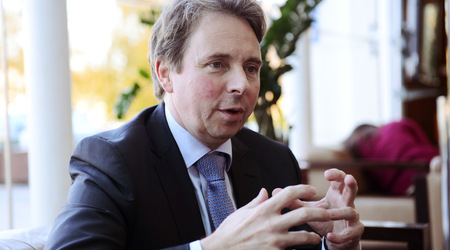
What's next after the Climate Conference?
We asked Marc Bichler – Luxembourg's Ambassador for Climate Change
The climate conference in Paris triggered great interest, attracting media attention worldwide and brought thousands of demonstrators to the streets of Paris, Amsterdam, London, Adelaide, Manila and, surprisingly, the Yemen capital Sana, where 70 people marched literally meters away from military actions. Experts wrote complicated analyses and forecasts, while artists made street art dedicated to climate change. In Bulgaria, both the media and the state of daily affairs, naturally, stayed focused on other issues certainly of greater importance than global warming. The Paris deal is now a fact. Almost 200 countries reached an agreement on an ambitious paper which sets the great goal to reduce global warming to 1,5°C and to please everyone – the small and the great, the poor and the rich … and also those island countries, whose future depends on the half a meter rise of the ocean level.
Is this possible? Is the paper too open for interpretations? We seeked the answers from His Excellency Marc Bichler - Luxembourg's Ambassador for Climate Change, participant of MOVE.BG’s conference “Sustainable Development as a Guiding Principle of the 21st Century” and one of the experts whose evaluation and consulting we at MOVE.BG count on regarding the issues of climate and sustainable development.
Critics of the Paris climate deal point out that the newly set temperature limit of “well below 2C” is not matched by an equally ambitious mitigation goal and see a commitment gap between this new global goal and the emission reduction pledges. What are your thoughts on that?
First of all, one must not lose out of sight that, in the agreement, the 2°C goal is complemented by an aspirational goal to make efforts in direction of a global temperature increase below 1,5°C. This is important, because it sets the political tone of the agreement, and it highlights indirectly how important the follow-up mechanisms that have been put in place, are. Initial Intended Nationally Determined Contributions (INDCs), as submitted on a voluntary basis by some 186 countries prior to the Paris conference, will be reviewed periodically to increase the mitigation ambitions. No back-sliding should be possible.
Some climate experts question whether 1.5°C is a real possibility and whether it would be enough. Are we being too optimistic and ambitious about the future?
The 1,5°C go has been introduced with the understanding that future review exercises will be informed by the contributions of the scientific community. As a matter of fact, the negociation process as such, leading up to the agreement in Paris, has greatly benefitted by credible scientific evidence of the anthropogenic causes of climate change, as it had been offered in the 5th IPCC Assessment Report.
There seems to be much confusion in understanding the term “greenhouse gas neutrality” in Article 3. The reference to the “net-zero emissions” has been opposed by many NGOs in the past. Is this a compromise language and what is actually behind those words?
One possible explanation may well be that the term “decarbonisation” was interpreted narrowly by some as relating only to a reduction in coal fuelled energy production. A successful negociation outcome depends often on taking all the parties redlines serious and on trying to find a common understanding to be expressed in universally acceptable language.
The absence of specific timeline for the long-term emission goal - reaching net-zero emissions after 2050, is seen as a weak point by some. Was this the only way to reach an agreement?
Successive review exercises, on a five year rhythm, will show how fast we can progress as an international community on this global challenge. A first objective will be to see greenhouse gas emissions peak as soon as possible, then to succeed in transitioning from fossil fuelled economies and lifestyles to economies and lifestyles fuelled by renewable energy before the end of this century.
The Paris Agreement sets different expectations for the rich and the poor. How will adequate climate finance be granted to help developing countries cope with climate impact?
Developed donor parties have re-acknowledged their obligation under the convention to provide climate finance to developing countries, both for mitigation and adaptation. Furthermore they have pledged to increase their financing, not least to live up to their past commitment to provide 100 billion dollars per year, as of 2020, for that purpose. While the agreement stresses the importance of public funding, financial flows may come from different sources, including from mobilized private sources. Other parties to the convention are encouraged to contribute to that financing effort on a voluntary basis.
How will progress be tracked for each country?
Countries which have not yet submitted their first INDC are re-invited to do so as soon as possible, in order to get a universal picture of national commitment to reduce greenhouse gas emission and its impact on the rising global temperature. Furthermore each party shall prepare, communicate and maintain successive nationally determined contributions that it intends to achieve. Parties shall pursue domestic mitigation measures with the aim of achieving the objectives of such contributions. The Secretariat of the UNFCCC will keep track of these commitments and publish them on its website.
The newly adopted agreement is yet to be deposited at the UN in New York and to be open for signature on 22 April 2016. Could you please walk us through the next steps of ratification and signature?
As a matter of fact, the UN Secretary General is requested in the agreement to organize a high-level signature ceremony of the agreement o 22 April 2016. Of course signing will remain possible even after such a ceremony. Ratification procedures vary from country to country according to their respective constitutional requirements. It is essential that ratification documents will be deposited by a critical mass of 55 countries, representing at least 55 per cent of greenhouse gas emissions, as soon as possible in order to allow the agreement to enter into force. Meanwhile parties to the agreement are at liberty to start applying the terms of the agreement on a voluntary basis.
What is the role of the EU and the different member states in regard to the new agreements?
The EU and its member states are happy with the outcome of this important climate negociation. They are acutely aware of their collective responsibility to deliver on their collective INDC. As the acting EU Presidency during the second semester of 2015, Luxembourg made every effort to have an ambitious EU negociating mandate in view of the Paris talks. We are delighted that our strong common EU position helped to forge a meaningful outcome of the negociations among 196 parties.
Finally, having in mind your recent visit in Bulgaria, how would you describe our country’s role and potentials within the context? What would your recommendations be?
Most of European member states are probably well advised to have a stark and honest look at ways and means to reduce their greenhouse gas emissions, either by increasing the part of renewable energies in their national energy mix or by improving their energy efficiency. Revisiting policies and practices regarding the energy efficiency of real estate, public buildings and industrial production sites is most certainly a good reflex in this regard. The promotion of increased use of public transportation would also help to live up to our new commitment under the Paris agreement.
Photo of Marc Bichler: Capital.bg
