A new campaign of “My Bulgarian History”
Why to digitize history and why we created "My Bulgarian history" - MOVE.BG
The rumble of explosions in the temple of Bel in Palmyra in August caught us somewhere in the quiet timelessness of the mountain, between the community center in Razlog and the house of one hundred years old woman in Bansko. We were in the midst of preparing the gatherings, the first of a series of events of myhistory.bg, which collect and digitize local community history.
The shockwave after the bombings in the Syrian temple shook world historical community within a radius of tens of thousands of kilometers from the conflict zone. The reaction is completely natural when talking about UNESCO monument of world importance.But there was no time for shock and the shock had been replaced by an action plan, and historians have suggested solution - the only thing that has any chance of winning the race for the documentation of the Syrian cultural heritage against the destructive element of the war.
Their decision, of course, is high technology. And the high tech people.
Over a thousand 3D cameras for scanning historical sites have been delivered to local activists, historians of the project The Million Image Database of the Oxford Institute of digital archeology. For months in the database have been accumulated thousands of documents and the Chinese company, a leader in 3D printing concrete, considering the possibility to recover these images already destroyed monuments. Soon in the region started the project Anqa (the Arabic word for phoenix) of CyArk, an organization that uses the latest laser scanning technology to create detailed 3D library of danger from natural disasters or human aggression heritage sites of Lights.
You may ask what is common between the ruins of a temple in the war-torn country in the Middle East and an old woman in Bansko collecting the last afternoon rays leaning against the wall. Both are matters of memory - a delicate and threatened with extinction. Both are carriers of history - perishable despite its apparent hardness and our assumption that maybe are timeless and can wait a little longer.
Why we created My Bulgarian history?
My Bulgarian history was created because of the untold stories that can not wait any more. Because of the stories that we do not want and can not afford to lose, because they are part of a colorful and integral picture of the common past. Those who, for one or another reason, aren’t always up in time for the history lessons, but are often the most delicate innards and drivethe complex machine of our cultural and national identity - the story of our family, street or our town, little known facts about important historical figures, our personal history.
Our solution of the challenge to write our common history is also - technology and tech people.
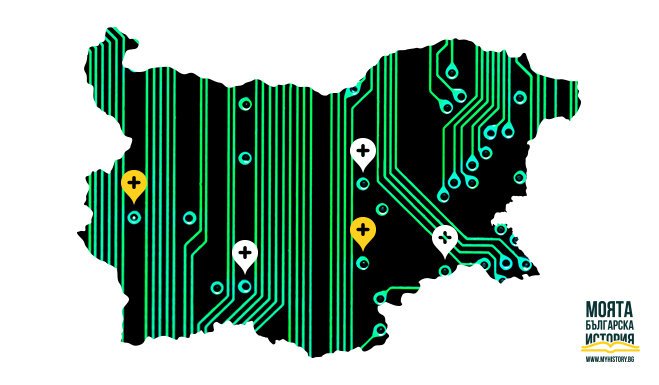
Myhistory.bg is a virtual historical map of Bulgaria, on which we write our story together. We chose to build my Bulgarian history about the principles of open science, the idea that each of us can be historian and storyteller.
The idea of Open science and citizen participation in the creation of science, of course, is not new, but as if patiently waiting for the right time to develop their full potential. Quite naturally this time comes with the development of social networks and technology. Internet is changing the rules of the game because it gives us the opportunity and the right to join, to participate actively together in creation of science.
Thanks to it, thousands of people scattered all over the world, simultaneously and in real time, solve complex problems, unaffordable for scientists a few years ago, thousands of people together doing mathematics or find solutions to problems of quantum mechanics, thousands decode the human genome, the number of birds or whales, monitor the migration of monarch butterflies, the quantities of green algae in the oceans, climate change, register new space objects, explore the phases of sleep ... So each of us has a chance to be an ornithologist, climatologist, astronomer, botanist and a lot more. Anyone can contribute. But what happens to the historians?
History is not a solitary activity
When talking about technology and digitalization, traffic on the beaten paths of academic historical science seems somehow unidirectional and slow. As if clumsy, page by page, it runs mostly from universities, libraries and museums to people, but almost never in the opposite direction - from ordinary people to the official historical science. Digitization of paper archives and the movable heritage is difficult and expensive process that requires special training and a lot resources. Really a lot of resources! The estimated cost to digitize Europe's cultural heritage, made recently by the European Commission are 100 bn. Euros.
Digitalization of history and culture and access are among the key priorities of the Common Strategic Framework for EU programming period 2014-2020. Their ambitions are 30 million. Cultural objects - books, paintings, documents, monuments to be available for free to everyone via Europeana - digital public museum of Europe. Europe wants free access for its citizens to the history and culture of their continent. Not quite so, alas, seems the situation in the text of the National Programme for Development Balgaria 2020. With interest still monitor progress in several Bulgarian projects related to the digitization of archives and objects that receive funding from the Norwegian program. None of them, unfortunately, does not provide for the active involvement of civic participation and shall not exceed the boundaries of many of the museum or library.
Liberation of history
Who has interest in monopoly over history is a conversation that could be short, but also long. This, of course, depends on the participants. In My Bulgarian history we believe that more rarely we hear a translucency worn cliché that "history is written by the winners" (or it was from the heroes of the day). For we know that today history is rewritten from the Internet that history is written by ourselves. That sure makes us all winners? Maybe not, but it gives an opportunity for all of us to be historians.
The mission of My Bulgarian history is to free the history.
Symbolic is the fact that we decided to launch the project on 2nd of April, the birthday of one of the emblems of our struggle for national liberation - Rakovski. For half a year on our virtual map formed a tableau of thousands of stories written by hundreds of people.
In September we completed the first of a series of events our gatherings in Bansko and Razlog. We gathered local community and their digitized spoken history in real time. The next meeting of the gatherings would be in Blagoevgrad in early November, then head to northern Bulgaria. Meanwhile, the platform continues to accumulate a lot of different stories from different parts of Bulgaria and the world.
My Bulgarian history is an online platform where the reader is a writer and a reader writer.
Virtual map My Bulgarian history stories of the past are written by all and available to all. Because we value the individual voice in the historic reading and because we believe that any personal Bulgarian history is our common history. Because we believe that every story is important, interesting, every story can be exciting and can test our values, to give us lessons for our common future here.
This is the story for a soup from leather belt and bread from the vine - story of my own grandmother for the winters during the Balkan War. As well as that of the first woman architect of Sofia - Victoria Angelova Vinarova. Or the story of one Bulgarian entrepreneur who made a fortune on postage stamps exhibition in Chicago in 1983 and even managed to find a place in "To Chicago and Back" Aleko. This is the story of the old woman in Bansko, who such as a monument of history leans a stone wall and collect the last afternoon rays. This is all Bulgarian history. This is your history.
Share it with us on myhistory.bg