
What is the state of green civil society initiatives in Bulgaria?
What challenges do they face?
How can these challenges be overcome?
We present a summary of the most important data on the state of green civil society initiatives in Bulgaria. The data was collected during the second edition of the national survey of green initiatives in Bulgaria, "Green Solutions from Bulgaria 2025," conducted by MOVE.BG, the results of which we presented in September.
Green civil society organizations today: the data
Similar to SMEs, many green civil society organisations are small in size. Close to one quarter of them (22.9%) operate entirely on the basis of the volunteer principle without any hired staff. More than 70% of the organisations in total have up to 10 employees, which raises the issue of their capacity to develop sustainably and to produce a lasting impact. In terms of thematic focus, most green civil society organizations work in the field of education - this is the most common activity, cited by 60.4% of green NGOs. A significant proportion are involved in initiatives related to climate (52%) and environmental protection, as well as the implementation of nature-based solutions (47.9%).
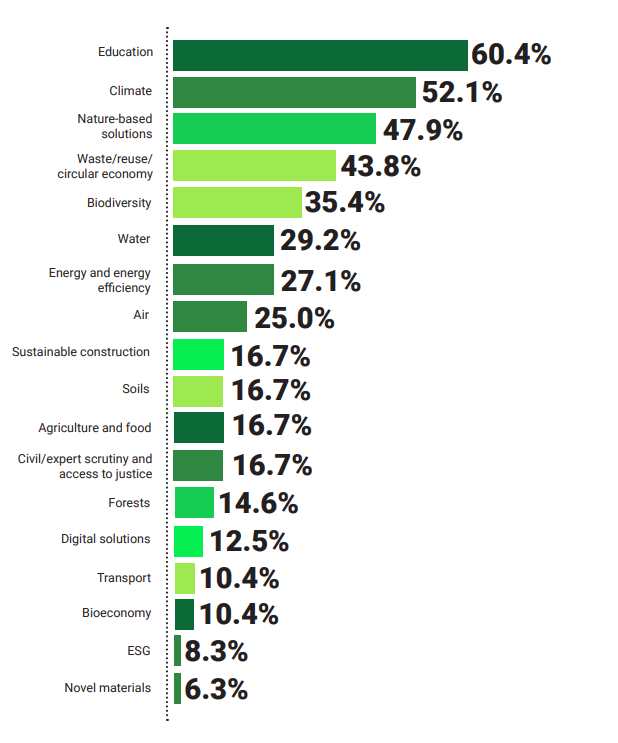
Which sphere is the main activity of your organisation/initiative focused on? Category of civil society organisations. More than one answer was possible.
Civil society organizations are establishing themselves as an innovative sector, albeit not so much in terms of technological or market products, but rather through social and organizational models. Over 38% of them develop social innovations related to new forms of civic participation, volunteering, or changes in public services, 14.7% experiment with interdisciplinary solutions, and 20.6% create breakthrough innovations. Just over 26% build on existing innovative models.
Funding for civil society organizations remains a major challenge. More than half of respondents (54.2%) rely on European grants and projects, and a similar proportion (56.3%) relies on their own funds, fundraising campaigns, and sponsorships. Partnerships with businesses are underrepresented (16.7%). The lack of long-term and stable funding is the most frequently cited barrier – 70.8% of respondents highlight it as a critical problem that hinders planning and sustainable development, followed by a lack of understanding from institutions and a lack of interest from the general public.
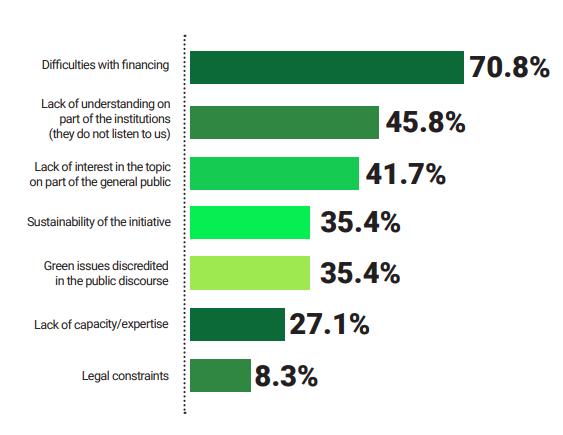
What are the main challenges to the development of your green initiatives? Category of civil society organisations and initiatives. More than one answer was possible.
In response to these challenges, the sector has formulated clear recommendations – the idea of creating a National Green Fund (70.8%) to provide stable and predictable national funding is the most strongly supported. Other measures supported by respondents include the creation of local advisory councils (68.8%), the creation of a national co-financing mechanism (66.7%), and the removal of administrative burdens (54.2%).
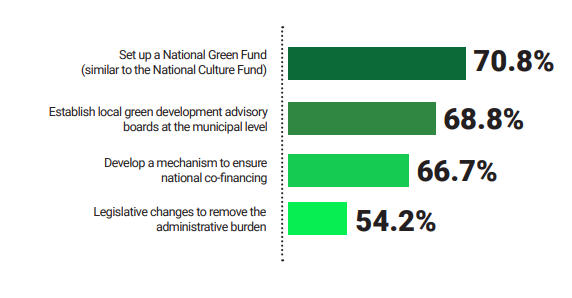
What government support measures are needed in your opinion? Category of civil society organisations and initiatives. More than one answer was possible.
Green Solutions from Bulgaria 2025: the data
The "Green Solutions from Bulgaria 2025" National Survey covers the three key groups for successful green transformation: startups, civil society initiatives, and research organizations working to support sustainable development. You can read a short article with summary data on green startups here (in ENG). Check out the report summarizing the survey data here (in ENG).


