MOVE.BG has published a special report, "Mission Green Innovation: A Prosperity Compass," which contains over 200 ideas for developing green innovation as a path to positive public development. The recommendations in the Compass are based on the ideas of 50 leading experts, who MOVE.BG brought together to formulate systemic solutions for the development of green innovation.
The five stops in the Compass
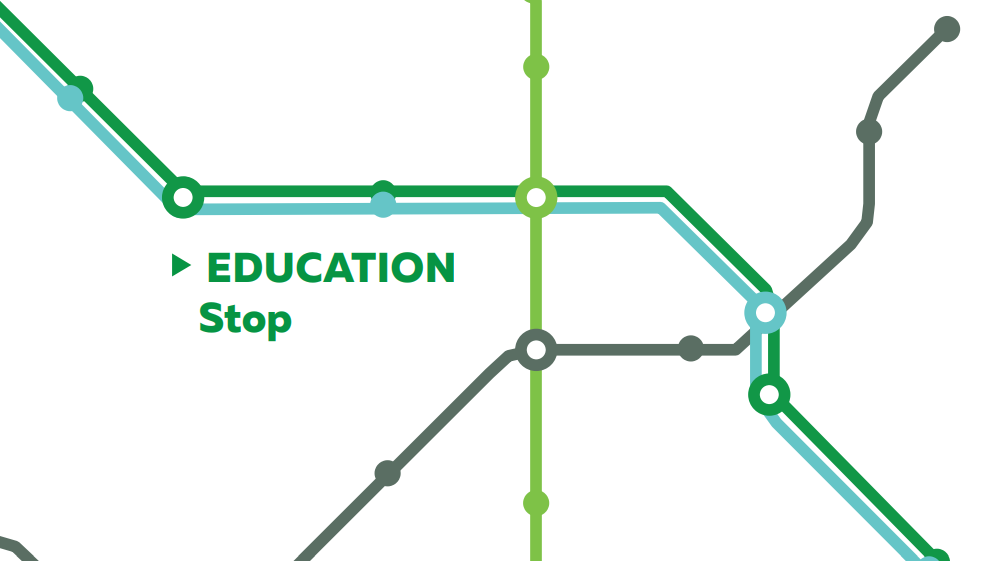
The Compass includes five stops on the road to public prosperity with the help of green innovation: Democracy, Education, Economy, Municipalities, and Finance. Each stop presents the ideas of leading Bulgarian experts with proven experience in the fields of science, business, sociology, the civil sector, the media, as well as representatives of political parties and the financial sector.
Today, we present the ideas from the Education Stop, which is dedicated to school and university education and their connection with green innovation. This stop presents ideas for educating students about eco-friendly living, how to support young green innovators in universities, and how to overcome the shortage of personnel in key areas of green development, such as engineering, which threatens our social development.
Education Stop
The following experts took part in the panel dedicated to education and green development:
- Reneta Bogdanova, Co-founder of SCI-HIGH Foundation, Specialist in methodological guidance, innovation, STEM at SoftUni Buditel, Panel Moderator
- Anton Batchvarov, Sales and Strategy Director at neuroVIZR Bulgaria, Partnerships team leader at Ucha.se (2015-2022)
- Ivaylo Bonev, Co-founder of Technokrati
- Ivan Gospodinov, Chair of Education without Backpacks, Khan Academy Bulgaria
- Ivelina Atanasova, Sustainable Development, Corporate Strategy and Communications Director, Rezolv Energy (2023-present); Business Development and Finance, Brown Forman (2012-2023); various financial and strategic roles, Accenture, CEZ BG, All data Processing (2004-2012)
- Professor Irina Ribarova, DSc, Engineer, University of Architecture, Civil Engineering and Geodesy, Sofia
- Liliya Elenkova, PhD, lecturer at the Public Administration Department of Sofia University St. Kliment Ohridski and at the Industrial Business Department of the University of National and World Economy. Author of the book The Development of Youth Policies in Bulgaria after 1989
- Mita Georgieva, Science Consultant in Programmes and Trainings at JA Bulgaria, Municipal Councillor in the Sofia City Council (2007-2011; 2011-2015; 2015-2019); long-standing teacher at the National High School in Finance and Business, Sofi
- Associate Professor Hussein Yemendjiev, Faculty Member of Burgas State University, Founder of ЕNOVA H2O startup
The experts participated in their personal capacity rather than as representatives of the institutions or organisations where they worked as of January 2025.
Before we present the ideas of the experts, let us have a look at the topic of the panel and the place of green development in it.
Green development and education: why do we discuss them together
Green education is the learning for the green transition and sustainable development, according to a recommendation by the Council of the European Union. Green education helps learners of all ages acquire the knowledge and skills needed to live more sustainably in an environment that is increasingly affected by climate change.
The main recommendations in the document are as follows:
- Establish learning for the green transition and sustainable development as one of the priority areas in education and training policies and programmes;
- Provide a range of learning opportunities in formal, non-formal and informal settings (e.g. extracurricular activities and work with young people), so that all learners increase their knowledge of the climate crisis and sustainability;
- Mobilise national and EU funds for investment in environmentally friendly and sustainable equipment, resources and infrastructure;
- Support educators in developing their knowledge and skills to teach about the climate crisis and sustainability;
- Create a favourable learning environment for sustainability, covering all activities and operations of educational institutions and enabling teaching and learning that are practically oriented, interdisciplinary and relevant to local contexts;
- Active involvement of students and staff, local authorities, youth organisations and the research and innovation community in sustainability training;
- Support programmes which encourage innovation and entrepreneurship in the field of sustainability;
- Strengthen the institutions for higher education and vocational education and training (VET) for establishing or strengthening sustainability centres to promote innovation and entrepreneurship oriented to the green transition and sustainable development, the circular economy, and biodiversity.
In 2022, the Joint Research Centre (JRC) of the European Union developed GreenComp, the European sustainability competence framework. GreenComp includes 12 sustainability competences organised in four key areas. These competences can be used in the design of educational programmes for general, vocational and higher education and lifelong learning. GreenComp is addressed to policy makers, educational institutions, teacher training organisations, assessment and certification bodies, employers, and research organisations.
The four competence areas include three key skills each. They are summarized below:
- Embodying sustainability values – this area includes the following competences: valuing sustainability, supporting fairness, promoting nature;
- Embracing complexity in sustainability – systems thinking, critical thinking, problem framing;
- Envisioning sustainable futures – futures literacy, adaptability (managing challenges in complex situations), exploratory thinking
- Acting for sustainability – political agency (orientation in political processes), collective action, individual initiative
Where does Bulgaria stand?
The Country Report on Bulgaria, which is part of the annual Education and Training Monitor of the European Commission (Education and Training 2024), contains the following findings:
“Surveys show there is scope to improve opportunities for students and teachers to learn about sustainability. In the 2022 International Civic and Citizenship Education Study (ICCS), 31.8% of Bulgarian schools surveyed reported that they offered all or nearly all their 8th-grade students opportunities to take part in activities related to environmental sustainability (IEA, 2023). The average for the 17 EU countries surveyed was 48%.
The study further shows that Bulgarian students have one of the lowest levels of knowledge of sustainable development among the 17 EU countries surveyed, scoring significantly below the EU average. These figures suggest that efforts are needed to close the policy practice gap and ensure a whole-school approach to sustainability.”
A major problem facing the education system in the EU and in Bulgaria is the gap between words and deeds regarding green education. In Bulgaria, some 75% of the students agree that we need to live in a more environmentally friendly way but only slightly over 20% apply more environmentally friendly practices in their everyday life. The average EU levels of these two indicators are 80% and 30% respectively.
As a result, the unresolved issues in school education affect university education and the development of science. The lack of human resources has been a major problem for science in Bulgaria for years on end. The first survey of green initiatives in the field of entrepreneurship, science and the NGO sector, which MOVE.BG carried out in 2024, identified the lack of human resources as a major problem for green research projects and their development, including scientific transfer: the lack of capacity and expertise was identified as an issue by 40% of all respondents in the survey Green Solutions from Bulgaria 2024.
The lack of motivation among students to pursue an academic career after graduation leads to substantial understaffing in many key sectors related to sustainable development and the green transformation. The insufficient number of hydro-engineers, which the media covered extensively because of the condition of dams in the country, is just one example of this effect.
The available data reveal that the number of students enrolled in the academic year 2023-2024 was 13% lower than 5 years before. The drop was the biggest in fisheries (-57%) and architecture and construction (-43%) but the necessary human resources for these sectors are still available on the labour market from previous years. The problem with programmes related to the environment and engineering is more serious because at present, just as was the case five years ago, the number of enrolled students continues to be lower than the needs on the labour market. The number of enrolled students in these two programmes dropped by 26% and 13% respectively.
The good news comes from the participation of Bulgarian universities through EU cooperation alliances within the framework of the European Universities Initiative of the European Commission. At present, 13 Bulgarian universities out of a total 51 higher schools in the country take part in various university alliances. The findings of a survey of the outcomes of the European Universities Initiative reveal that the participation of a university in European alliances greatly promotes the development of green skills, according to 84% of the respondents in the survey.
The opinion of experts
What happens to education and green development in Bulgaria?
This section of the Report presents a summary of the opinions that experts expressed in the panel discussion dedicated to school, university and informal education and green development.
The ideas are summarized and grouped together by the team of MOVE.BG without any claims that they have been approved unanimously by all participants in the panel.
Challenges
Challenges in school education:
- Lack of skills to apply knowledge to practice
- Lack of skills to analyze problems and make prospective decisions
- Problems with the authority of schools and teachers
- Lack of motivational programmes for students to get involved in social processes aimed at positive changes
- Insufficient motivation to build communities around schools
- Insufficient or non-existent coverage of green innovation in classes
- Low levels of functional literacy among students
- School achievement gap: children perform well where parents have the means to set off deficits through additional classes and private tutors. Schools do not perform well where this is not possible.
- Lack of an adequate programme to identify the needs of individual students and to create customized opportunities for catching up and overcoming deficits, as well to develop talents and strengths.
Challenges in university education:
- Teacher training programmes are not selective: all applicants get enrolled and most of them graduate
- Lack of linkage and upgrading along the pupil-student-professional career chain;
- Lack of sufficient human resources in key areas of climate policies and their implementation
- Disastrous shortage of engineers because of a missing national policy for strategic occupations
- Lack of a government policy to make studies of crucial importance for the green development of the country attractive in view of the professional career of young people
- Lack of motivation to continue with an academic career in science
- Lack of an effective system regarding the number of universities and their geographical allocation
- Lack of a national mechanism for partnership between businesses and universities
Solutions Compass
Ideas of the experts on school education:
- Introduce the interdisciplinary principle and the holistic approach in school education: show the interlinks of individual subjects
- Develop a teacher training programme on the role of the holistic approach in education and the ways of implementing it
- Develop a programme to boost the functional literacy of students
- Develop a programme on how to apply knowledge in practice
- Carry out a public awareness campaign among parents on the role of schools and teachers
- Develop a mechanism to involve parents in school processes and to explain the objectives of the educational process even before school age
- Develop a mechanism to involve parents in school processes up to the age of 10 of their children
- Develop a mechanism to improve communication and trust along the teacher-parent-student chain
- Develop a training programme for students on how to analyze problems and make prospective decisions
- Develop an empowerment mechanism and responsibility training for students: students should be responsible for the implementation of some school projects
- Develop a programme dedicated to the importance of sustainable lifestyle and the role of individuals in the protection of the environment
- Develop an interactive programme for students to present good practices in the sustainable lifestyle and the protection of the environment
- Introduce gamification in the education on sustainable lifestyle and the protection of the environment, including digital hackathons dedicated to green issues
- Model the school environment in a way which fosters learning from it
- Deploy a scheme for providing school libraries with books on environmental topics
- Explore the opportunities for collaboration with influencers and their involvement in the educational processes for more interactive communication and for attracting the students’ attention to green development
- Develop a mechanism for cooperation between schools and municipalities to involve students in municipal environmental projects
- Involve students in nature conservation activities at and around schools
- Develop a training programme on green innovation and circular economy
- Develop a national strategy and a roadmap for the promotion of green innovation accelerator programmes at schools, focusing on the search for innovative solutions of the issues facing the municipality where the school is located. Provide central and/or local government funding for the implementation of the ideas
- Set up informal environmentalist clubs to organize activities related to the sustainable lifestyle and the protection of the environment
- Develop a national teacher training and support programme on topics related to climate change and the role of human activity, the introduction on sustainable practices in everyday life and the protection of the environment, promotion of the importance of science and green innovation
- Establish a green certificates scheme or a rating system for the implementation of environmentally friendly practices at schools, including a checklist with the requirements that schools should meet
- Draw up a catalogue of good practices at schools in the country for motivation and experience sharing
Ideas of the experts on university education:
- Analyze the labour market to identify the human resources gap in areas of key importance for the national development
- Develop a national strategy to attract young people to key specialties related to the implementation of climate policies and the management of natural resources
- Implement urgent measures to make engineering a more attractive choice for young people
- Develop a mechanism to attract students to laboratories, including collaboration with secondary schools and visits by pupils
- Develop a national strategy and a roadmap for the promotion of green innovation accelerator programmes at universities, including support to spin-off companies with protected rights of young entrepreneurs. Provide central and/or local government funding for the implementation of their ideas
- Reform university education on the basis of an analysis of the number and quality of universities
- Deploy a national mechanism for cooperation between businesses and universities – apply the mechanism of developing projects for solving local problems (within the area of the university). Allocate teaching hours for business representatives
- Develop a programme to encourage student mobility
- Develop a mechanism to involve students in nature conservation activities around and at the university/campus
- Develop a mechanism to empower students in implementing green practices, e.g. organisation of competitions for projects to improve the environment at the university/campus
- Develop a mechanism to encourage student communities: clubs, councils, informal interest groups
- Establish a green certificates scheme or a rating system for the implementation of environmentally friendly practices at universities, including a checklist with the requirements that universities should meet
- Establish a green certificates scheme or a rating system for the implementation of environmentally friendly practices on campuses, including a checklist with the requirements that campuses should meet
- Promotion of good green practices of universities/student communities/campuses, for instance, via a YouTube channel. It could be set up and maintained by the National Representation of Student Councils
The challenges and solutions outlined here are based on the ideas which the participants in the panel generated. The ideas are summarized and grouped together without any claims that they have been approved unanimously by all participants in the panel.
Check all recommendations in the Compass here (in ENG).

Mission Green Innovation
The Compass is part of the Mission Green Innovation, an initiative of MOVE.BG in support of green innovators in Bulgaria. At MOVE.BG, we know that Bulgaria has the potential to be among the green and innovative leaders in Europe. Therefore, we should support the creators of innovation that can change the face of the Bulgarian economy from a resource-based to a value-based one.
Learn more about the various initiatives of MOVE.BG in support of green and innovative development in Bulgaria here (in ENG).


