In the month the organization celebrates its 13th anniversary, Sasha Bezuhanova, founder of MOVE.BG, has given an interview to Bulgarian National Radio (BNR).

Can you explain with one term the idea behind the access-based economy? Do you know what are collaborative innovative spaces? What does mean Body 2.0?
The answer to all questions is social innovation.
Social innovation is a process of “inventing, securing support for, and implementing novel solutions to social needs and problems,” according to Stanford University. A process, which is not a privilege to one state, structure or organization. To be successful, social innovation needs cross-sector and multi-disciplinary efforts.
The access-based economy, the collaborative innovative spaces, and the Body 2.0 are a special type of social innovation - the so-called RSBs or Radical Social Innovation Breakthroughs. The European Commission has published a study, identifying RSBs, which are relatively new and have the potential to reshape our world. The list is the second part of a new innovation scanning report “100 Radical Innovation Breakthroughs”. The study, which has been conducted by a group of pan-European experts, includes 13 RSBs along with 87 Radical Innovation Technologies.
Social innovations are part of the human societies and play a significant role in societal development, but they are organized in a different way compared to technological innovations, the authors of the report explain. For example, a new tech invention could be still in an experimental phase and not implemented in the economy or society while social innovations are trends that are already part of our life. They challenge the existing rules, systems, and norms and can disrupt and radically change our way of living soon. According to the experts, the identified 13 RSBs can be adopted in 2038.
“People often draw a distinction between technological and social innovations. New movements in society create knowledge about how to do things differently, often emphasizing behavioural aspects rather than the role of technical artefacts. This does not mean that technology does not play a role in social innovations,” the authors say.
“The way in which technological and social innovations will combine to shape future industries and sociotechnical regimes can be a matter of considerable uncertainty and speculation. We see so much disruptive potential around us that we are confident that the industries, sectors and value-chains of the future will not be like the ones of today.”
The 13 identified RSBs are:
- Collaborative Innovative Spaces;
- Gamification;
- Access-Based Economy;
- Read/Write Culture: diversifying information gatekeepers;
- Reinventing Education;
- Body 2.0 and the Quantified Self;
- Car-free city;
- New Journalist Networks;
- Local Food Circles;
- Owning and Sharing Health Data;
- Alternative currencies;
- Basic Income;
- Life Caching;
Collaborative Innovative Spaces
The new, innovative forms of associations, knowledge sharing, and creative activities have led to the creation of hubs of skilled people or the Collaborative Innovation Spaces. They work as places where people exchange ideas, knowledge, and various tools, the EU experts say. Makerspaces, coworking, hackerspaces, and shared labs are examples of that RSB. The European Union is performing very well in Collaborative Innovation Spaces and they will be widely adopted across the bloc after 19 years, the expert group claim.
According to the study, the makerspaces are on a constant rise with 1,400 active hubs across the Union at the moment, which is 14 times more than in 2006. Makerspaces allow the democratization of several activities such as design, engineering, education, and fabrication.
Gamification
Gamification is the process of implementing gaming elements and tools in everyday life or business practices. It is used for improving the engagements of various groups:
- Employees - in order to achieve higher organizational productivity;
- Voters - to increase political engagement and fight apathy;
- Traffic participants - to lower law violations
- Students - to improve learning process;
- Entrepreneurs - to implement new and more successful crowdsourcing practices.
Many companies also use gamification projects to train employees, to improve productivity, and to recruit and retain the best talents. In recent years, many firms and projects have combined data-generation with gamification in order to attract professionals from various sectors and to stimulate multi-disciplinary.
Moreover, gamification solutions can improve one of the most important business strategy aims - to gain and increase customer loyalty.
Access-Based Economy
'Access,' 'sharing' or 'platform' are terms of describing the so-called commons-based economy - a new form of organizing business work and access to goods and services. In the access-based economy, business partners do not rely on a third party for market pricing or managerial issues. That RSB is driven by several factors:
- The increased penetration of the Internet and especially the mobile one because it has significantly lowered the cost of economic collaboration;
- The boom of social networks, which have stimulated the sharing of information and digital goods;
- The digitalization of more and more goods - music and books have become widely available via digital technology;
- Consumer needs, which have shifted towards experience rather than ownership;
- The economic and environmental crisis, which have encouraged people to seek new forms for sharing scarce resources.
“Through an access-based business model, goods and services are traded based on access rather than ownership. This can be organized by the company that owns the resources (e.g. ZipCar), or through a platform that is merely connecting owners/ service providers and users as in the case of Airbnb,” the EU experts write in the report.
Read/Write Culture: diversifying information gatekeepers
Social media enables people to become active audiences as users can not only share but also generate and transform journalism content. Applications like Facebook, YouTube and Periscope convert citizens into content creators. The US philosopher Lawrence Lessing has described this RSB as “read/write culture”, which is 180 degrees opposite to a “read-only culture” where information or product is provided to passive consumers by a professional source. According to the EU experts, the diversifying of information gatekeepers has taken place in a relatively short time with consequences not yet fully understood.

Reinventing Education
Digital technologies are changing the educational system because applications, peer-to-peer platforms, and online courses opened the learning process to a wider public. The education is no longer limited to formal institutions as many digital projects offer online courses on various subjects. Peer-to-peer platforms enable people to share knowledge and to teach each other. Moreover, leading European universities have opened their lectures online and made them available to people who do not have time or finance to study Bachelor or Master degrees.
Body 2.0 and the Quantified Self
“Quantified Self movement encourages users to better understand themselves by collecting data on every aspect of their daily life: from food consumption, air quality, blood oxygen levels, arousal, to bowel movements and so on. The slogan of the movement is “self knowledge through numbers”. The Quantified Self movement is also known as “lifelogging”,” the report reads.
“Body 2.0 and Quantified Self both mean the permanent monitoring of the human body and the almost medical monitoring of one's bodily functions, via wearables, Smartphone Apps or separate sensors. The new technical possibilities are combined with an increased concern over the body as “the temple” where the mind resides.”
Car-free city
Transforming modern overpopulated cities into more healthy and environmentally friendly places for a living requires reduction of traffic jams and the numberof transport vehicles. Therefore, car-free city social innovation depends on the stimulation of public transport, cycling, and walking practices. That RSB can reduce:
- petroleum dependency;
- air pollution;
- greenhouse gas emissions;
- automobile crashes;
- noise pollution;
- traffic congestion.
New Journalist Networks
Journalists around the world have combined efforts and resources to make significant, societal important investigations about global challenges and problems such as corruption, climate change, and abuse of power. Cross-border collaboration has become very easier and not so expensive due to digital technologies. One of the most prominent examples of the new journalist network is the 2015 Panama Papers investigation, which revealed a network and methods for tax evasion and other unlawful financial practices.
Local Food Circles
Local Food Circles is a new form of sustainable agriculture, which aims to stimulate safe and locally-grown food with environmentally friendly means. It radically changes the existing growing and consuming practices. Localized food systems, indoor gardening, and community gardening are examples of Local Food Circles. One of the most successful practices is permaculture - it integrates “ethical approach to designing healthy, productive, sustainable, planet-friendly systems where humankind works with nature rather than against it.”
Permaculture is part of the MOVE.BG’s green program, City Jungle, which educate about innovative environmental practices and modern forms of green economy.
Owning and Sharing Health Data
“Personal health data are becoming more and more valuable. There are movements to create spaces, in which the persons who are the subjects of the data know that their data are safe and can be used, e.g. for research, and in which individuals benefit directly from providing their data. This is a counter-initiative against companies exploiting personal health data generated in different situations, intentionally and unintentionally,” the experts explain.
Alternative currencies
Alternative currencies are financial means that aim to replace or supplement the fiat money. One of the most popular forms are cryptocurrencies such as Bitcoin (BTC) and Ethereum (ETH). They are decentralized systems, underpinned by blockchain technology. The digital coins are still not widely used due to several challenges, including regulatory control and scalability.

Basic Income
Basic Income or Guaranteed Minimum Income (GMI) is a social welfare concept, which obliges states to guarantee GMI to all citizens in order to meet their basic needs. The issue creates hot debates around the European Union with various opinions. Currently, there are two forms of GMI:
- Unconditional Basic Income (UBI), when there are no requirements for receiving the money;
- Conditional Income, which is provided if people meet certain conditions or fulfill certain duties.
Life Caching
Life Catching means putting all digital memory and tracks, related to one person in one place, and keep them forever. The aim is all videos, pictures, spoken words, texts, and any other form of memory not to be forgotten. Life Catching is a major trend in the United States with 2.5 billion spent last year.
Radical Social Innovation Breakthroughs
The experts have measured how the identified 13 RSBs will expand in 2038. They have used a 5-degree scale with a one (1), meaning that a particular Radical Social Breakthrough will be hardly adopted while five (5), showing that an RSB will become widely spread in the society.
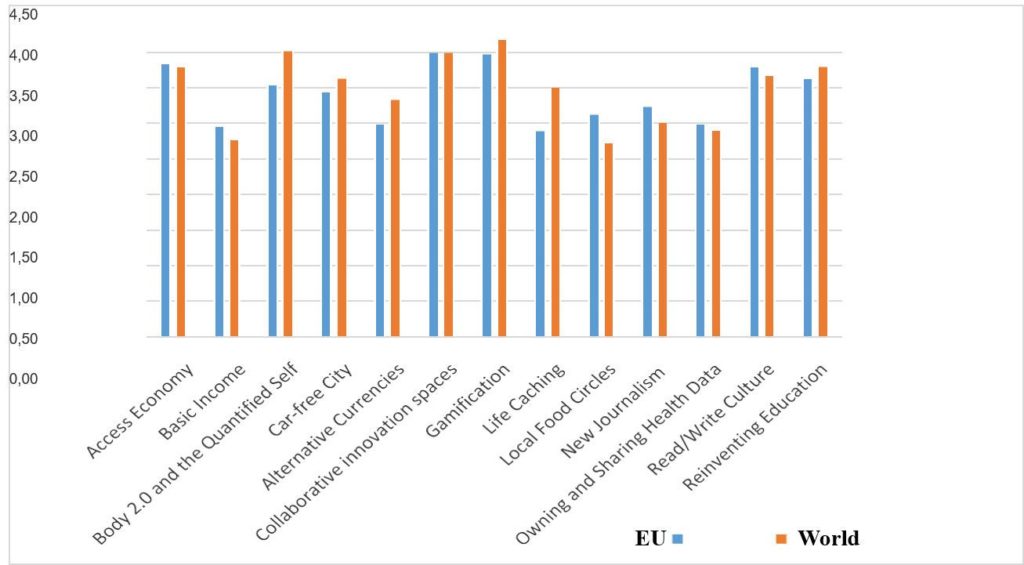
“[All 13] social practices are of a different nature from the technological RIBs. As social innovations are local by nature and are reported and monitored much less systematically than science and technology developments, the ones with the potential to disrupt global value creation patterns will be few and are mostly already far advanced,” the authors of the report conclude.
MOVE.BG and Radical Social Breakthroughs
Coworking by MOVE.BG is a Collaborative Innovation Spaces. It is a place where you can work and share ideas. A space where you can meet like-minded people, get support for your ideas, exchange expеrience, and share your cause.
We are making our tomorrow together!
You can read an article about the 87 Radical Innovation Technologies here.