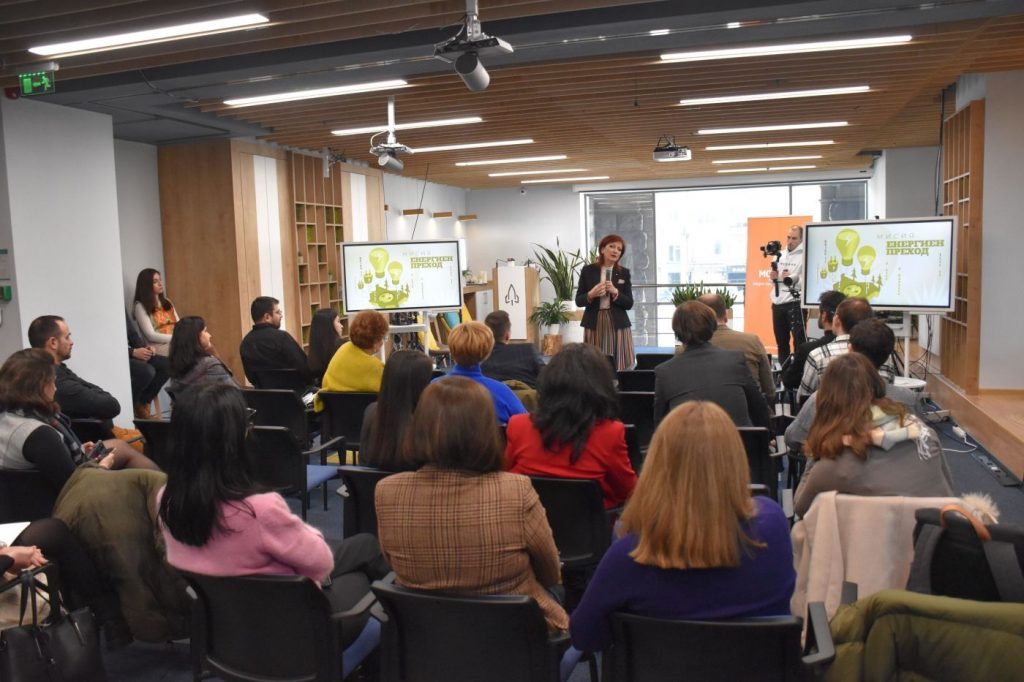
The Green Restart Coalition, initiated by MOVE.BG has brought together over 50 of Bulgaria's leading experts in a special event in support of Bulgaria's energy transformation - Mission Energy Transition. The initiative, which took place in February in Sofia, generated over 100 proposals for reforming the key energy sector towards net l-zero emissions. In the coming days, the ideas will be summarized in a special report that will be published in March. The report will also be sent to stakeholders in Bulgaria, including political parties and representatives of the legislative, executive, and local authorities, as well as the European institutions.
Mission Energy Transition is the latest initiative in support of sustainable and innovative development in Bulgaria by the Green Restart Coalition, in which MOVE.BG, WWF Bulgaria, "Greenpeace"-Bulgaria, and the "Institute for Circular Economy" have been working together for almost three years. The forum Mission Energy Transition was opened by Sasha Bezuhanova, founder of MOVE.BG and initiator of the Green Restart Coalition. Among the participants in the event were representatives of innovative Bulgarian science, experts from the NGO sector, representatives of local authorities, journalists, communication experts, sociologists, experts from various ministries and government agencies, as well as representatives of businesses and local communities working on the topic of energy transformation.
Mission Energy Transition: why is it needed?
The Green Restart Coalition had decided to organize the Mission Energy Transition because Bulgaria lags behind on key energy transition indicators - the transition to cheaper, more affordable, and cleaner energy.
Bulgaria's lagging progress in decarbonizing the energy sector threatens our country's overall development and prosperity. In Europe and Bulgaria, energy is among the main contributors to greenhouse gasses, and therefore this sector is one of the main polluters of the planet. For this reason, the energy transition is at the heart of sustainable development policies at the European level.
What are the figures?
Bulgaria continues to be the country with the most energy-intensive economy in the European Union - 3.5 times the European average - a problem that makes Bulgarian goods and services uncompetitive and unattractive.
Over 27% of households in the country are energy poor, compared to an EU average of 8%. This is a problem that goes far beyond the inability to heat our homes adequately in winter or cool them in summer. Energy poverty has an impact on our working capacity; children's concentration while studying at home; our physical health; on our mental health, including being a cause of depression and stigmatization.
Bulgaria also has serious difficulties with the energy efficiency of its building stock. For example, 74% of educational institutions in the country (schools, universities, and colleges) are below the minimum threshold of energy class C, and only 0.97% are class A - the class with the highest degree of energy efficiency and with optimal energy performance.
This is just some of the data. At the same time, Bulgaria is not implementing the opportunities for economic and social development, new jobs, and a cleaner and healthier environment that the European Green Deal brings. The Deal is the European Union's long-term economic transformation strategy that aims to make Europe the first climate-neutral continent by 2050 - to produce as much greenhouse gas emissions as nature can absorb naturally.
It is estimated that the Green Deal measures are expected to create over 2.5 million new jobs by the end of this decade. By 2030, the overall transition to cleaner forms of energy is expected to create over 10.3 million jobs globally, and with new positions associated with grid improvements for renewable energy capacity, this figure is expected to exceed 13.3 million and thus offset nearly five times the expected loss of over 2.7 million jobs in the coal industry.
One of the measures of the European Green Deal specifically related to making a successful energy transition is to support the economic transformation of coal regions through the Just Transition Fund. Under its mechanisms, Bulgaria will receive over €1.3 billion for the economic transformation of the three coal regions - Stara Zagora, Pernik, and Kyustendil. A few months ago, however, Bulgaria lost the first BGN 200 million (EUR 100) of the funds because of the delay in the official submission of the territorial plans of the three regions.
Mission Energy Transition: Let's hear the experts
Bulgaria has proven experts who have the knowledge needed to address key challenges such as the energy transition. By relying on their expertise, we can overcome Bulgaria's serious energy transition backlog, which threatens the prosperity of our society, the health of our people and environment, and the economic development of our country.
That is why on February 13th we brought together over 50 experts from different fields in Mission Energy Transition. Together with the experts, we discussed the challenges to making a successful energy transition in Bulgaria, and generated solutions to overcome them.
The participants were divided into five working groups, related to the main issues facing Bulgaria's energy transformation:
- Communication for a Successful Energy Transition - moderator of this group was Sasha Bezuhanova, founder of MOVE.BG and initiator of the Green Restart Coalition
- Sustainable use of biomass - moderated by Apostol Dyankov, Head of the Climate and Energy Programme at WWF Bulgaria
- Energy Communities - moderated by Balin Balinov, coordinator of the Energy Solutions campaign at Greenpeace Bulgaria
- Energy Poverty and Energy Efficiency - moderated by Svetoslav Stoykov, co-founder of the Institute for Circular Economy
- Just Transition of Coal Regions - moderated by Georgi Stefanov, a climate expert

What's next?
In the coming days, the Green Restart Coalition will summarize the recommendations of participants in a report that will be presented at a special discussion in March. The report will then be sent to stakeholders in the country, including political parties and representatives of the legislative, executive, and local authorities, as well as the European institutions.
The Green Restart Coalition and the experts' ideas
Mission Energy Transition is the third event of the Green Restart Coalition's World Café format for generating ideas through work in groups. The first World Café, held in 2020, led to the generation of a number of ideas for turning the National Recovery and Sustainability Plan (NRRP) into a long-term strategy for the green and innovative development of Bulgaria. Some of the ideas have been included in the NRRP, such as the support for innovative Bulgarian startups with a “Seal of Excellence”.
In 2022, the Second World Café, held by the Green Restart Coalition, focused on Bulgaria's sustainable development, addressing six key areas: green innovation, bioeconomy and biomass, sustainable finance, smart cities, nature-based solutions, and energy independence through clean forms of energy and decentralization of the energy system. During the event, over 150 challenges to Bulgaria's green development were identified and over 150 recommendations were generated to overcome these problems. The Green Restart Coalition summarized the ideas in the special report Mission Green Bulgaria (link here in English).
Learn more about the activities of the MOVE.BG-initiated Green Restart Coalition here (in English).


